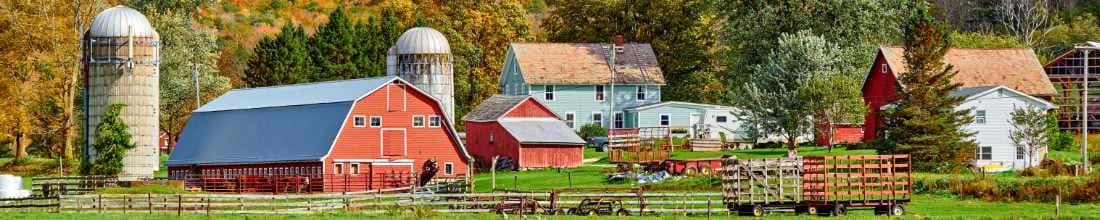
Feeding the Soil
Years ago, my brother ran a small organic farming operation (let the reader understand). I spoke to him once about what made it "organic," which for him was one simple principle that guided everything else. The industrial approach, he explained, is to use chemical fertilizer to feed the plants to make them grow more quickly. This is an effective technique, and we can all be grateful it exists, but it wasn't his approach. He didn't feed the plants, but rather he fed the soil itself. Feed the soil, he said, and the soil feeds the crop.
Imagine your company as a farm. At scale, it takes a lot of hands to run the operation, and those hands are all busy doing different things, pursuing different intermediate outcomes. The ground has to be tilled and leveled. Seed has to be planted and watered and fertilized. Someone has to do pest control. The crop actually has to be harvested, and maybe post-processed. And at some point, it has to be delivered to the actual buyer. All this time, tools and vehicles have to be maintained. Old gear needs to be replaced. New hands have to be trained. The list goes on.
Each hand on the farm might have their own individual objective during a particular part of the season, but the entire operation shares one overriding goal: a bountiful harvest, growing year after year. Everybody working on the farm, no matter what outcome they're individually focused on at the moment, supports that end.
You can imagine parallels between all of these jobs and what goes on in the go-to-market organization of a typical technology company. It takes a huge array of specialized roles working together to make the operation run, and all of them, ideally, are contributing toward the end goal of selling the product to enthusiastic customers who are better off for using it. Demand gen people plant seeds, counter-positioning product marketers do pest control, content marketers and events people water and cultivate, and sales people eventually harvest the crop. (And yes, this is a simplification. Sellers, for example, can be involved in the whole process from seed to harvest. Don't let's press the analogy too hard!)

In some kinds of technology businesses, there's a large gap between the buyer and the user. Most kinds of infrastructure present a clear example of this: only developers can actually make use of it, but the spend is controlled by someone higher up in the org chart, detached from direct interaction with the product. This means you can't approach developers and treat them as if they're potential pipeline. It's not that developers don't buy things, or resent marketing in any form, or are so purely focused on their new agentic development workflow that the mere mention of commercial life sends them scurrying—it's simply that the tools they use to build systems are typically not tools they themselves purchase. It does no good to try to sell them something they lack the power to buy.
They may lack the power to sign a PO, but it would be a critical mistake to say that they lack power altogether. Far from it! Decades ago, before open source made its impact on the world, it was possible for a salesperson to close a sale on some meaningful infrastructure component over a round of golf. Developers would then find out on Monday morning that they were using Oracle or DB2 or Sybase or IMS running on an AS/400—they had no say in the matter. These days, though, senior developers and architects will provide critical input to validate a vendor's technical claims, and it may even be the case that a successful sale will require strongly positive grassroots support for the technology among rank and file developers before a company even shows up on the radar as stage-one pipeline.
Developers don't appear to be in the approval chain for most interesting enterprise sales, but what they are is the soil in which software sales germinate and grow. If you don't have soil, you don't have a farm. In the same way, if you don't have bought-in developers in your community, you don't have a successful business. This is the task of developer relations: to feed this soil.
And it's worth looking closely at actual soil. It's not just particles of silicon dioxide and inert organic matter, but an impossibly diverse array of fungi, bacteria, tardigrades, nematodes, isopods, worms, and more, all forming a complex, living ecosystem. Remember my brother, the organic farmer? He took pains to cultivate just the right fungi and bacteria and nematodes—he said the nematodes were particularly tricky—to feed his soil. Feed the soil, and it feeds the crop. Feed the crop, and you've got a growing harvest.
There is a potential developer community—think of it as the total addressable developer market—who could potentially derive value from your technology. Do they know about it? Do they understand how it fits into their world? Have you given them opportunities to play with it, risking only their time? Have you helped them make the best use of agentic workflows to build systems with it? Are you capturing the enthusiasm of your biggest fans to help build an even stronger community? If you're not answering yes to all of these questions, you are busy running a farm without knowing whether you’ve even got soil at all. A robust Developer Relations program might just be what you need to close the gap.
Comments
No comments yet. Be the first!